What makes you fanatical? When my children were little it was those little stuffed animals called beanie babies. They loved building a collection and searching for their favorite animals when they were in a new store. For my sister it is fall foliage. She lives in a part of the United States that most would consider absolutely gorgeous but come October she yearns for the gold, orange and red hues of the leaves, fields of pumpkins and the smell of the crisp air in the northeastern part of the United States. And me? Well I do confess that a chocolate shop can raise my blood pressure but so can a fabric store. You're not surprised are you? We were recently asked where we get our fabrics for the stoles at Carrot Top Studio. Here are a few examples of our many sources...
Commercial fabrics, like in this stole, are accentuated with hand painted details. The base blue of this stole is very common fabric from a national retailer. The border is specialty fabric purchased from an online quilt store.
It's exciting to be able to use fabric that supports ministries like this border fabric that is from the Congo Cloth Connection. Our purchase of this fabric supports a ministry of the Mennonite church where they believe "every stitch is a prayer" and which they build relationships with their brothers and sisters in the Democratic Republic of the Congo. We have used some of their fabric in a red stole here and this fall will debut one in green and one in purple.
We are slowly finding more resources for eco-friendly fabrics such as the tone on tone white background fabric of this labyrinth stole. Bamboo is a sustainable plant because it grows so quickly. We also like it because the texture is silky smooth.
Supporting other artists with our fabric purchases has been quite a privilege. We offer a line of stoles using hand dyed silk used in the appliques. The silk is dyed in LaCroix, Haiti by a delightful group of young women. Our purchase of the silk and in turn your purchase (we give 50% back) supports the women's education fund.
Lastly we haunt several different sources for vintage fabric. We consider this re-purposing of the fabric to be another earth friendly source that is good for our stoles and honors this world's creation by not allowing good fabric to end up in a landfill. We have several of these on the cutting table to add to our new fall inventory. We're also working on stoles created out of fair trade fabric. We dream of using a lot of fair trade fabric but we've sadly been challenged with finding resources that are affordable so we can keep our price point in a good spot for our clients. We'll keep searching for fabrics here and there. You can make sure to stay tuned to the website and our Facebook page to see what's new!
Wednesday, August 29, 2012
Monday, August 13, 2012
Inspiration from Tomie dePaola
We're drawing a close to summer here in Pittsburgh, PA where our studio is located. But this doesn't mean we can't sneak in some unstructured days that include reading just for fun. This weekend we breezed through Tomie dePaola: His Art and His Stories by Barbara Elleman. I used dePaola books when I was teaching and especially loved The Art Lesson because it expressed a lot of the sentiment as to why I became an art teacher. I am drawn to dePaola's illustrations, the well balanced artistic layouts and incredibly thought out details of the pages of his books. It was a lovely surprise and thrill to read in this biography that the artist briefly designed church vestments!
I additionally was drawn to this statement," In Books and Religion, writer Mary Zeman, an artist and educator interested int he spiritual growth of children, comments that [dePaola's] voice is that of a receptive man,whose approach to his work betrays what Thomas Merton once described as the willingness of saints 'to answer the secret voice of God calling--to take a risk and venture by faith outside the reassuring and protective limits of our five senses.'" This makes me think of worship, how we do it, see it, experience it, etc. I understand and embrace that the visual is just one component.
To make the reader aware of how symbols are important to this artist's work the author explains the possibly puzzling image of Mary, the mother of Jesus on one of dePaola's book jackets who is holding an apple. Of course this fruit is more typically associated with Eve in the Old Testament. Here it is appropriate as a symbol for the virgin Mary because it was her son who took away the curse of sin. The artist didn't originate this symbol as the apple was used this way in medieval paintings. But it is exciting to know that dePaola applies his knowledge of the past to encourage us to make visual connections today. Learning how dePaola is drawn to the history and use of religious symbols helps me to further understand why I have felt a connection and admiration to his work. I certainly don't have the artistic credibility of dePaola but I'd like to think that we put similar thought and credibility into the how and why we use symbols in our work at Carrot Top Studio.
I additionally was drawn to this statement," In Books and Religion, writer Mary Zeman, an artist and educator interested int he spiritual growth of children, comments that [dePaola's] voice is that of a receptive man,whose approach to his work betrays what Thomas Merton once described as the willingness of saints 'to answer the secret voice of God calling--to take a risk and venture by faith outside the reassuring and protective limits of our five senses.'" This makes me think of worship, how we do it, see it, experience it, etc. I understand and embrace that the visual is just one component.
To make the reader aware of how symbols are important to this artist's work the author explains the possibly puzzling image of Mary, the mother of Jesus on one of dePaola's book jackets who is holding an apple. Of course this fruit is more typically associated with Eve in the Old Testament. Here it is appropriate as a symbol for the virgin Mary because it was her son who took away the curse of sin. The artist didn't originate this symbol as the apple was used this way in medieval paintings. But it is exciting to know that dePaola applies his knowledge of the past to encourage us to make visual connections today. Learning how dePaola is drawn to the history and use of religious symbols helps me to further understand why I have felt a connection and admiration to his work. I certainly don't have the artistic credibility of dePaola but I'd like to think that we put similar thought and credibility into the how and why we use symbols in our work at Carrot Top Studio.
Thursday, August 02, 2012
Signs and Symbols
This week's gospel lectionary text is John 6:24-35. Using signs and symbols is a great tool
throughout the Bible and this is a story in which bread becomes "I am the bread of life", a symbol for Jesus Christ. Some symbols are important to the culture of the time but bread is still one we can relate to today.
The lines and colors in this art make me think of the energy and fuel we receive from actually eating a loaf of bread but is also symbolic of the life we receive through Jesus Christ. We see similar images in our worship spaces including sheaves of wheat which is a reference to bread.
In the studio we too use the bread or wheat symbols whenever we can. For example on these two stoles...
The teacher in me is always looking for connections and when I stumbled up this statement by Dietrich Bonhoeffer it seemed like a perfect sentiment to end this post with. He said, "The table fellowship of Christians implies obligation. It is our daily bread that we eat, not my own. We share our bread. Thus we are firmly bound to one another not only in the Spirit but in our whole physical being. The one bread that is given to our fellowship links us together in a firm covenant Now none dares go hungry as long as another has bread, and anyone who breaks this fellowship of the physical life also breaks the fellowship of the Spirit."
throughout the Bible and this is a story in which bread becomes "I am the bread of life", a symbol for Jesus Christ. Some symbols are important to the culture of the time but bread is still one we can relate to today.
The lines and colors in this art make me think of the energy and fuel we receive from actually eating a loaf of bread but is also symbolic of the life we receive through Jesus Christ. We see similar images in our worship spaces including sheaves of wheat which is a reference to bread.
![]() |
| Bread of Life by Kennedy A Paizs |
| Go here to see this ordination stole. |
| This Communion stole can be seen on the website here. |
Wednesday, July 18, 2012
Inspiration
Believe it or not, there is no rule book on how to run a small business creating ministry stoles and worship banners! So sometimes people ask, "where do you get your inspiration?" Honestly, it comes from a lot of places. Among the many sources of inspiration an example might be having observed a great color combination in nature on our daily walk and then feeling compelled to try to replicate it. Or it might be a piece of fabric stumbled upon in a fabric store, that nudges us to combine it with other fabrics and symbols for a new stole. Of course we also love visiting all different types of worship spaces as there is almost always something inspiring in the architecture, the liturgy or the message of the service. But last week you might have read on our Facebook page that we'd taken a field trip. This inspirational junket included a stop at our local art museum where Henri Matisse's The One Thousand and One Nights (seen below) was on display.
The One Thousand and One Nights was created in 1950, when the artist was 81 and permanently confined to a wheelchair after complications from an intestinal operation severely weakened him. The artist was unable to sleep and found himself kept alive by his drive to create. This very large (5 1/2' x 12') beauty is inspirational to me because it tells a story with lines and shapes that seem so very carefree and expressive. It gives you a lot to think about through its simplicity. I appreciate that the color combinations and layers that are at times unique while breaking the rules of theory. Additionally if you examine the work closely you can see pencil lines and pin holes. Discovering the markings causes chills to run up and down my spine. It makes this man seem real as I grasp that Matisse had made a plan and then had felt it necessary to readjust. One lesson learned: we often think we know what the result needs to be in a project (art or otherwise) but we are wise to let the process transform the end result. But what touches me the most is that Matisse felt the need to keep creating. He had been a painter but with his age and his ailments he had to reinvent how he created art. Paper and scissors allowed him this freedom of expression. This artwork is inspirational. It makes me want to design stoles that have bold flat shapes that tell a story. But inspiration and encouragement also come from the way the artist lived his life despite his challenges.
Monday, July 02, 2012
The Making of a Commissioned Ministry Stole
Several months ago I was thrilled (ok, actually I was positively giddy!) to respond to a request to create a stole for the moderator of the 220th General Assembly of the Presbyterian Church USA. This was special for several reasons. First, the commission came to be because someone told someone who told someone about Carrot Top Studio and the unique stoles we create. This is how our business has been built and we are continuously grateful. Secondly, the General Assembly is in our hometown of Pittsburgh, PA this year. In the midst of the behind the scenes planning of this event we've been so proud to discover how the people of the "Burgh" would be extending hospitality and wrapping the time together in prayer. Lastly, I come from a very long line of Presbyterians (I'm at least a fourth generation) and I am proud and thankful for this heritage.
This commission gave me wonderful artistic free reign with the criteria simply being that it should represent the GA scripture from Isaiah 40:31 (but those who wait for the Lord shall renew their strength, they shall mount up with wings like eagles, they shall run and not be weary, they shall walk and not faint) but also reflect Pittsburgh. Here's a little documentation of how we came up with the finished product:
First step in a new stole design is to "audition" fabrics on the design wall to make sure the values and prints are compatible and create visual balance. Choosing the sky fabric was our greatest challenge and the blue in this image didn't make the cut! What we ended up working with was a piece of vintage blue denim. The vintage quality of the fabric seemed to shout, "remember those that have gone before you!"
Pittsburgh has 446 bridges. We thought a bridge was a great symbol for the moderator's stole because we think of the General Assembly as a place where a lot of ideas are bridged together. As the stole components were put into place we weren't sure which bridge would serve this piece the best. The Roberto Clemente bridge (on the left) that leads from downtown to the home of Pirates baseball at PNC Park seemed to be the best choice. On the finished stole (at the end of this post) you can see that the bridge is set above the three rivers that come together at the point of Pittsburgh. Of course this liturgical artist sees the number three as spiritually significant here!
There are times that we get caught up in a creative zone. Our left brain has learned to leave our right brain notes during these moments so we won't forget to do things--like add the birds above the bridge that represent "soaring in hope."
I've always admired the PCUSA seal because it speaks to so much about our faith. Personally, I've always seen the Holy Spirit, the activeness of studying and proclaiming the Word (because the Bible is open not closed) and the Baptismal font. It's actually deeper than that and you can read about the seal here. During our brainstorming phase it was exciting to learn that permission was granted for us to use this trademarked image on the moderator's stole.
We have many hills in Pittsburgh so couldn't resist including a few! The medium green fabric used in the hills of Pittsburgh is from Malawi where our Pittsburgh Presbytery has a longstanding partnership.
The back tip of the stole is a rising sun. Artistically throughout history the sun has been used as a symbol to represent "the son." On this stole it is in the midst of a colorful sun rise. We thought this was fitting imagery as a symbol of hope because we are blessed to have the light of Jesus replacing the darkness. The colors of the sunrise have been created using fabric hand dyed from a ministry my Pittsburgh church home has in La Croix, Haiti. The silk scarves are dyed by LaFemme de la Croix at the New Testament mission in Haiti and the sale of the scarves in the United States benefits the women's education. I've worked side by side with these dynamic young women and it was meaningful to include a piece of this silk that came to be because Christians from two very different communities were able to work together. This is a reminder that we are one in the Spirit.
What else reflects Pittsburgh on the 220th GA stole? We toyed with including a pierogi or Pirmanti Brothers sandwich but an incline won out instead. Inclines originally dotted the mountain side surrounding the city and allowed for the movement of people and supplies as the population expanded in the 1800's. Today there are two inclines left and they tend to be a favorite tourist stop.
And here's the finished product that was presented to Rev. Dr. Neal Presa after he was installed on Saturday night at the GA. We pray that it will be a fitting visual tool during his ministry.
This commission gave me wonderful artistic free reign with the criteria simply being that it should represent the GA scripture from Isaiah 40:31 (but those who wait for the Lord shall renew their strength, they shall mount up with wings like eagles, they shall run and not be weary, they shall walk and not faint) but also reflect Pittsburgh. Here's a little documentation of how we came up with the finished product:
First step in a new stole design is to "audition" fabrics on the design wall to make sure the values and prints are compatible and create visual balance. Choosing the sky fabric was our greatest challenge and the blue in this image didn't make the cut! What we ended up working with was a piece of vintage blue denim. The vintage quality of the fabric seemed to shout, "remember those that have gone before you!"
Pittsburgh has 446 bridges. We thought a bridge was a great symbol for the moderator's stole because we think of the General Assembly as a place where a lot of ideas are bridged together. As the stole components were put into place we weren't sure which bridge would serve this piece the best. The Roberto Clemente bridge (on the left) that leads from downtown to the home of Pirates baseball at PNC Park seemed to be the best choice. On the finished stole (at the end of this post) you can see that the bridge is set above the three rivers that come together at the point of Pittsburgh. Of course this liturgical artist sees the number three as spiritually significant here!
There are times that we get caught up in a creative zone. Our left brain has learned to leave our right brain notes during these moments so we won't forget to do things--like add the birds above the bridge that represent "soaring in hope."
![]() |
| Creating the stencil for the seal applique. |
I've always admired the PCUSA seal because it speaks to so much about our faith. Personally, I've always seen the Holy Spirit, the activeness of studying and proclaiming the Word (because the Bible is open not closed) and the Baptismal font. It's actually deeper than that and you can read about the seal here. During our brainstorming phase it was exciting to learn that permission was granted for us to use this trademarked image on the moderator's stole.
We have many hills in Pittsburgh so couldn't resist including a few! The medium green fabric used in the hills of Pittsburgh is from Malawi where our Pittsburgh Presbytery has a longstanding partnership.
The back tip of the stole is a rising sun. Artistically throughout history the sun has been used as a symbol to represent "the son." On this stole it is in the midst of a colorful sun rise. We thought this was fitting imagery as a symbol of hope because we are blessed to have the light of Jesus replacing the darkness. The colors of the sunrise have been created using fabric hand dyed from a ministry my Pittsburgh church home has in La Croix, Haiti. The silk scarves are dyed by LaFemme de la Croix at the New Testament mission in Haiti and the sale of the scarves in the United States benefits the women's education. I've worked side by side with these dynamic young women and it was meaningful to include a piece of this silk that came to be because Christians from two very different communities were able to work together. This is a reminder that we are one in the Spirit.
What else reflects Pittsburgh on the 220th GA stole? We toyed with including a pierogi or Pirmanti Brothers sandwich but an incline won out instead. Inclines originally dotted the mountain side surrounding the city and allowed for the movement of people and supplies as the population expanded in the 1800's. Today there are two inclines left and they tend to be a favorite tourist stop.
And here's the finished product that was presented to Rev. Dr. Neal Presa after he was installed on Saturday night at the GA. We pray that it will be a fitting visual tool during his ministry.
Friday, June 22, 2012
Summer Reading
Carrot Top Studio is headed out of town today for a week of rest, relaxation and rejuvenation. We appreciate your clients patience as shipping will be on hold from today until July 2nd.
I grew up absolutely absorbed in my library's summer reading program. Thanks for signing up for that Mom! Reading still brings great pleasure and my bags are packed with probably three weeks worth of choices instead of just one! Here's a little of our selection:
Passing the Colors : Engaging Visual Culture in the 21st Century by Chris S. Overvoorde who is professor of art emeritus at Calvin College. In this book he addresses challenges faced by artists who long to remain in the church. The purpose of this piece is to demonstrate how important the visual is to worship and devotion and how including artists in faith communities strengths the ties that bind. I've never felt unwelcomed by the church as an artist but I think this book will expand my thinking.
I'm almost a year away from turning fifty. Wow! So I'm taking a friend's recommendation and packing Jubilee Time. She used it in a class about seeking spiritual direction in the second half of life at Pittsburgh Theological Seminary. Reading her course description made me intrigued. Typically I don't make a big deal out of birthdays in general or even milestone birthdays but this book looks to be interesting and the format seems great as it's written by the author but infused with writings and thoughts from others. I wonder what I'll be challenged to think about?
I couldn't resist already starting to read Awaken Your Senses: Exercises For Exploring the Wonder of God by J. Brent Bill. This topic takes me back to when I was a elementary art teacher and there was much emphasis on teaching to the many different learning styles students have. I've always felt that this applies to worship as well. Some people connect visually, but others through the auditory, tactile, kinesthetic, etc. Bill applies this notion to our five senses and our personal faith. I suspect that much of this will translate easily to corporate worship as well and might open my mind to new ways to use our work in the studio.
Due to my passion for and recent trips to Haiti I also hope to read through Following Jesus Through the Eye of the Needle: Living Fully, Loving Dangerously by Kent Annan. I am more and more constantly reminded of how comfortable my life is. I don't believe this is what it's called to be but boy is it tricky to give that up! As I continue to pray for what God has in store for me next I suspect Annan's personal experience might give me a glimmer insight for my life.
And lastly, I must admit I love "reading" cookbooks. The creative soul in me really likes cooking also, but a cookbook that tells stories of the how and why of the recipe is doubly delicious (pun intended!) So Ripe by Nigel Slater is a super large volume that will probably be absolutely devoured. And because I won't be actually making the recipes during the reading it will be very skinny on calories.
And you? What's on your summer reading list?
I grew up absolutely absorbed in my library's summer reading program. Thanks for signing up for that Mom! Reading still brings great pleasure and my bags are packed with probably three weeks worth of choices instead of just one! Here's a little of our selection:
I'm almost a year away from turning fifty. Wow! So I'm taking a friend's recommendation and packing Jubilee Time. She used it in a class about seeking spiritual direction in the second half of life at Pittsburgh Theological Seminary. Reading her course description made me intrigued. Typically I don't make a big deal out of birthdays in general or even milestone birthdays but this book looks to be interesting and the format seems great as it's written by the author but infused with writings and thoughts from others. I wonder what I'll be challenged to think about?
I couldn't resist already starting to read Awaken Your Senses: Exercises For Exploring the Wonder of God by J. Brent Bill. This topic takes me back to when I was a elementary art teacher and there was much emphasis on teaching to the many different learning styles students have. I've always felt that this applies to worship as well. Some people connect visually, but others through the auditory, tactile, kinesthetic, etc. Bill applies this notion to our five senses and our personal faith. I suspect that much of this will translate easily to corporate worship as well and might open my mind to new ways to use our work in the studio.
Due to my passion for and recent trips to Haiti I also hope to read through Following Jesus Through the Eye of the Needle: Living Fully, Loving Dangerously by Kent Annan. I am more and more constantly reminded of how comfortable my life is. I don't believe this is what it's called to be but boy is it tricky to give that up! As I continue to pray for what God has in store for me next I suspect Annan's personal experience might give me a glimmer insight for my life.
And lastly, I must admit I love "reading" cookbooks. The creative soul in me really likes cooking also, but a cookbook that tells stories of the how and why of the recipe is doubly delicious (pun intended!) So Ripe by Nigel Slater is a super large volume that will probably be absolutely devoured. And because I won't be actually making the recipes during the reading it will be very skinny on calories.
And you? What's on your summer reading list?
Thursday, June 14, 2012
World and Church
I've been reading about love and God. I'm drawn to what Mother Theresa teaches when she said, "do not think that love, in order to be genuine, has to be extraordinary... Do not pursue spectacular deeds...In the work we have to do it does not matter how small and humble it may be, make it Christ's love in action." This seems like a great message for Ordinary Time when we celebrate God with us, God for us and God through us. Within this I am grateful for a God who insists on both incorporating us into a nourishing, worshiping community and mobilizing us as his compassionate, transforming presence in the world.
![]() |
| prom ready |
So what is your world? My world this week consists of a daughter who has just completed her junior year in high school. She spent a very festive night dining and dancing at prom and then having a group of friends to our home for the rest of the evening. Through subtle acts (such as providing their favorite pop tarts for breakfast!) I pray that these young people experienced our home to be a place where they were all welcomed. That the small, humble acts of hospitality were a demonstration of Christian hospitality.
![]() |
| with one of my nieces |
Lastly, we're planning our next mission trips to Haiti possibly in November but definitely in February. We participate in the mission of God. We all are capable of this on a daily basis but are also at times called to leave our neighborhood to do the work. This might be the neighborhood next to ours or it could be half way around the world. In Haiti we've been able to evangelize, serve the poor, educate, and worship in community alongside the Haitians. We are also able be the salt and light to each other--as brothers and sisters in Christ. This shouldn't surprise me but I still am greatly moved by the memory of a Haitian friend telling me on my second trip that he had been praying for me since our first encounter six months prior. Awww yay....Christ's love in action.
![]() |
| Our current collection of stoles created using silk hand dyed in Haiti can be seen here. |
Wednesday, May 30, 2012
Trinity Sunday
Preparing for Trinity Sunday I think back to creating a meditation banner as a commission for a client in Great Britain. When Carrot Top Studio became a business eight years ago we didn't anticipate liking one of a kind commissions. The lovely surprise has been that we really enjoy these projects because it stretches our knowledge and challenges our creativity. It's also a wonderful way to get to know our clients better as the commissions often have a very personal nature to them.
When we created this small banner with our interpretation of Rublev's Icon of the Trinity we had not been familiar with this work of art that was originally created in 1410. It depicts the three angels who visited Abraham at the Oak of Mamre--but is often interpreted as an icon of the Trinity. The original icon is full of symbolism from the dove to the house to the colors of what the figures are wearing and even how they are seated. We highlighted the oak tree which serves as a reminder of the tree of life that was standing in Eden and of the cross. The oak tree for Christians can be a symbol of courage and strength and the three leaves reiterate the message of the Trinity.
Interested in a commission for a stole, a banner, or other type of fiber art that might be used to make a visual connection to the Word? Email us your ideas and we'd love to enter into a discussion regarding your needs (and dreams!)
PS...interesting to note that pre-Christian Celts ate acorns from the oak tree to help with preaching preparation. I'm thinking it's good we've gotten' past this tradition!
Wednesday, May 23, 2012
Pentecost
The work of the church continues today and this Sunday we will pause in worship to recall the story of the formation of the first church. Reaching into American art history archives we thought to share this image for Pentecost.
![]() |
| Can Fire in the Park, Beuford Delany, 1946 |
Vivid colors thick on canvas convey the need for fire for the homeless in the city. Around the fire is heat, light, life, comfort, and community.This is a reminder to "guide us down the dusty roads of this world so that we may lift up the downcast, heal the broken, reconcile what is lost, and bring peace amidst unrest." (Garth House, Litanies for All Occasions)
See Can Fire in the Park at the Smithsonian American Art Museum.
See stoles for Pentecost by Carrot Top Studio here.
Wednesday, May 09, 2012
Church Architecture: Our Heritage
Why is our church architecture configured the way it is? Did you ever stop to think about that? Occasionally I have had the privilege of leading an adult Sunday seminar class within my own home church community. It's always a pleasure partly because the attendees are often the older/wiser type and I adore their company. Secondly I am usually academically stretched when preparing these one hour talks. And this is a good thing. This past week I was really challenged with the subject matter of how the Reformation changed church architecture. I'm not an expert on this topic...I know the art component. But I do really enjoy research and am grateful to have opportunities to dust off my "teacher" hat. Here's a synopsis of the presentation that kicked off a four week series on sacred space....
![]() |
| A stone altar discovered south of Isreal. Might this be what Noah's looked like? |
An early Old Testament example of worship was when" Noah built an
altar to the Lord and, taking some of all the clean
animals and clean birds, he
sacrificed burnt offerings on it." Genesis 8:20 (God was pleased and Noah was blessed.)
Another Old Testament worship setting is in Numbers 9:17, ‘Whenever the cloud lifted from above the
Tent, the Israelites set out; wherever the cloud settled, the Israelites
encamped’.…the tent was continually being
re-pitched… and this was unique to other religions of the time that had to
pilgrim to one set location to worship. Having worship today in the communities we live in is a blessing. The Old Testament way remains today. Thank you God.
T The New Testament tells of Jesus and then the early Christians worshiping in each other's houses.
![]() |
| This is what we think house worship might have been like. It makes me think of what many of our worship spaces represent today also! |
After the early Christians there was much growth and development including the reason why church architecture developed the way it did.
![]() |
| At one point it was believed that you needed to be a monk to get to heaven. It was difficult being a monk and it was difficult even getting to some of the monasteries as you can see in this image. |
![]() |
| Gothic architecture was very vertical so that the building actually pointed toward heaven. |
The beginning of the Protestant Reformation saw an outburst of iconoclasm....the removal of statues and images from churches. Because Reformists couldn't instantly build their own churches they made modifications in existing architecture.
![]() |
| This Roman Catholic cathedral in Grossmunster, Zurich is an example of a church who had their walls whitewashed of murals when the Protestants started to worship in the space. |
The major message of the Reformists was people gathering in a spirit of intimacy for a shared ministry of word and sacrament. Therefore pulpits became large and often had a sounding board above them to give visual emphasis to the word and to help improve the acoustics.
![]() |
| This is the pulpit at Oude Kerk in Amsterdam. What a prominent figure it makes within the architecture! |
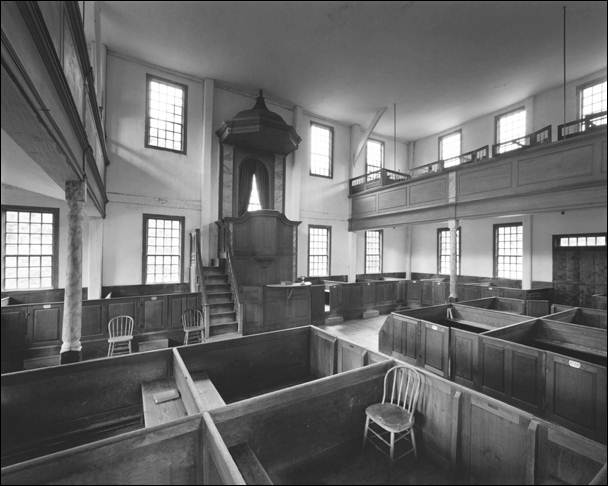
The Puritans were Reformers who in America built meetinghouses for their worship spaces.The image of the Sandown Meeting House in New Hampshire is another great example of how important preaching the Word was.
Reformed theology can even translate into the architecture of a mega-church. This is Coral Ridge Presbyterian in Florida. The pulpit with it's large sounding board is given major emphasis and the seats are arranged in a way for every participant can see and hear. The Reformers believed that Word of the Lord was for everyone and the architect of this large church kept that in mind
Given that this post is from Carrot Top Studio, I suppose you're wondering what the Reformists would say about our worship banners and ministry stoles? We'd like to think that our works are not icons but merely pieces of fiber art that are used to enhance worship and help the people make a visual connection to the Word. Wouldn't be fun to have John Calvin or Martin Luther chime in on that subject?
Wednesday, May 02, 2012
Preparing for Palm Sunday
Preparing for Palm Sunday? Now? Really? Of course, in theory, we should always be looking ahead to avoid doing things in haste. For example, the joyful celebration of Palm Sunday has not left my mind since hearing a friend describe her experience of Holy Week on a recent trip to Germany. Throughout history many faith communities have reenacted the moment Jesus fulfilled prophecy and rode into Jerusalem on a donkey. Most use palm branches because that mimics what was done in Jerusalem. Have you ever paused to think about why Palm branches? Well of course...palm trees were part of the landscape so they were readily available. But my friend worshiping in Germany on Palm Sunday had the pleasant surprise of the congregation waving bits of boxwood cuttings to remember the joyful entry of Jesus. Why boxwood? Because the boxwood plants are part of the landscape in this part of Germany and were readily available. Carrot Top Studio is trying to be a better steward of our resources by using eco-friendly fabrics in our stoles as often as possible. This focus has heightened our awareness of other efforts made in this way. And therefore when I learned of the boxwood branches on Palm Sunday I had an ah-ha moment. This sounds like a very sustainable demonstration of using what is local. I know some congregations use the palms at the end of worship to turn them into ashes for Ash Wednesday, and some people fold their palm branches into crosses as a devotional image to focus upon, but what about all of those palm branches that just get thrown away at the end of worship.....after the expense of shipping them a great distance in the first place? Are there better ways to celebrate? There are eco-friendly efforts among some growers so at least the palms are being provided in a way not to destroy plants. If you are interested in these eco-palms you might appreciate this article. But, maybe we can go a step further in our efforts as we plan for what will visually enhance our worship services to accent the Word and draw us deeper into our faith. Maybe you have ideas you can share? Regardless thanks for listening! Putting my soap box away....now...
Friday, April 27, 2012
Journeys
![]() |
| Martin Sheen journey's in The Way |
Sometimes when I have to do routine, no thought required tasks in the studio, I pop a movie in to keep me motivated. Yesterday I watched, The Way starring Martin Sheen. It focuses on his character's journey on the El Camino de Santiago. Have you seen it? I've always enjoyed Martin Sheen's acting and he did not disappoint here as emotions ran the gamut while I laughed, cried and was awestruck by the scenery while cutting fabric for your new stoles.This movie is not necessarily a theological piece but one reviewer says he left the theater wanting to go on "a walk to find what Celtic Christians called the thin places … places in which God's presence is more deeply felt. A pilgrimage to … it didn't much matter where, as long as it brought me closer to God."
![]() |
| DuBose Conference Center, TN |
While I'm dreaming of where my pilgrimage might be (I've always wanted to hike the Appalachian Trail) I've been working on a talk I'll give for an adult Sunday School seminar in my home church. The series is entitled "Sacred Space" and I will present the opening session which will focus on "Church Architecture: Our Heritage." We're looking at sacred spaces basically since the Reformation. It's made me think once again about what our worship spaces say regarding our liturgical practices. Does the journey into worship allow for a gathering of community? Does the worship space allow for movement...processionals, coming forward to the Lord's table and liturgical dance for example. Does the space allow everyone to be active participants in worship? Does the placement of the font indicate that Baptism is a communal act?
Whether your worship space is as simple as this outdoor space shown at left or something much more complex, try to see it with fresh eyes. Sometimes little things can make a difference. The movement of a piece of furniture (maybe the font), the removal of a too long used worship banner or where the reader of the scripture stands can draw attention to what the worship space is declaring about our faith and help draw us closer to God as we journey with Him.
Interestingly Image (a journal of literature and the arts) releases a movie list each year. This year they focused on the "Top 25 Road Films" --they're stories about journeys! Quite a few on this list I haven't seen and now I think I need an arts and faith discussion group to coincide with my viewing -- and maybe a few more mundane tasks so I can work my way through the list!
Wednesday, March 28, 2012
Multi-Sensory Worship
I had the opportunity this week to spend any evening with friends as we shared a Seder dinner. It was meaningful because we rejoiced with the story of the exodus through the spirit of the Jewish tradition by giving thanks for deliverance and redemption. We also recalled that Jesus asked all of us to do this in remembrance of Him. Many of us reenact part of the Seder dinner at our various Communion Services, but the entire Passover ceremony brings a profound sense of meaning. I was touched by this ancient teaching tool because it applied to all of my senses.
| See this "Joyful Feast" stole & other Communion stoles here. |
I actually recall a Seder dinner the family life committee sponsored in the church community that I grew up in. Despite the fact that many years have gone by since this 'event' occurred the memory is vivid probably because the meal was multi-sensory.
Why dwell on this? First it's appropriate as we prepare for Holy week! Secondly it is a great example of how including multi-sensory experiences help us be engaged and place the main idea into significant context. Classroom teachers know that if you can incorporate the visual, the auditory and the tactile you can imprint a memory. Isn't that what a Seder dinner does? How else can we learn from this teaching model as we plan our worship services?
Tuesday, March 13, 2012
Stoles Created from Congo Cloth
Trying to be a better steward of this good earth a call was put out to clients and friends to find sources for fabrics that were organic or sustainable that we might start incorporating into our ministry stoles.
One connection led to another which led us to a group within the Mennonite church that hosts a project that connects church women and men in North America and the Democratic Republic of Congo through the beauty of cloth, prayer and personal relationships.
Cloth is a hallmark of Congolese culture and creativity. We, like many others, were quickly drawn to its bold beauty. We therefore anxiously anticipated the appearance of the first fabrics we purchased!
The day arrived and tears ran down our face when the package was opened and the story of the fabric was read. The motto of this ministry is "every stitch a prayer." Ahhhhh. Sigh. How lovely!
| This stole can be seen in full here. |
And now we've had time to sew with just a bit of this sumptuous fabric to create a design for Carrot Top Studio's Easter collection. This stole (detail at right) uses the Congo fabric just in the border but we look forward to using the other Congo fabrics we have added to our fabric stash in even bolder ways. Two projects in the Congo will receive monetary benefits from the sale of these fabrics. One is a sewing training center and workshop to help start young women on their careers. The other is a sewing group that helps women who have been victims of sexual violence by teaching them fiber arts skills.
You may read more about the Congo Cloth Connection here.
Wednesday, March 07, 2012
Celebrating the Christian Year with Food
I was thrilled to discover the book A Continual Feast by Evelyn Birge Vitz. It's a great match for my passion for honoring the rhythm of the church year and for creating in the kitchen and trying new foods. Maybe this suits you also? The author speaks of fasting and the giving up of particular foods during the season of Lent. The giving up of certain foods and culinary pleasures can enhance this period of prayer and turning to God. If you are keeping everything simple during this season--including your meals--you might appreciate this recipe included in the cookbook.
Lentils with Cumin and Coriander
1 cup dried lentils
5 cups water
2 medium onions, chopped
2 cloves garlic, shopped
1/4 cup olive oil
1 teaspoon ground cumin
1 teaspoon ground coriander
1/2 teaspoon salt
freshly ground pepper
It was for a dish probably quite like this one that Esau sold his birthright (Genesis 25). Lentils especially strongly spiced, were a popular dish at the time of Christ.
Rinse the lentils and carefully pick over to remove any pebbles.
Bring 5 cups of water to a boil in a large saucepan. Add lentils and boil for 2 minutes, then remove them from the heat and set aside for 1 hour.
In the meantime, saute onions and garlic in olive oil. When the lentils have soaked for 1 hour, add the onions, garlic, cumin, and coriander to the pan with the lentils.
Cook, partly covered, for 1 hour more, stirring occasionally, until the lentils are quite soft and the water is mostly absorbed. Add more water if necessary to keep the dish from drying out too much, but the mixture should be thick.
Add salt and freshly ground pepper; taste for seasoning.
Yield: 4-6 servings.
What is served at the table when we break bread together can be a visual reminder of the season of the church year at your church dinners and in our homes. Cooking, serving and sharing food enriches our lives in many ways...even during Lent.
Lentils with Cumin and Coriander
1 cup dried lentils
5 cups water
2 medium onions, chopped
2 cloves garlic, shopped
1/4 cup olive oil
1 teaspoon ground cumin
1 teaspoon ground coriander
1/2 teaspoon salt
freshly ground pepper
It was for a dish probably quite like this one that Esau sold his birthright (Genesis 25). Lentils especially strongly spiced, were a popular dish at the time of Christ.
Rinse the lentils and carefully pick over to remove any pebbles.
Bring 5 cups of water to a boil in a large saucepan. Add lentils and boil for 2 minutes, then remove them from the heat and set aside for 1 hour.
In the meantime, saute onions and garlic in olive oil. When the lentils have soaked for 1 hour, add the onions, garlic, cumin, and coriander to the pan with the lentils.
Cook, partly covered, for 1 hour more, stirring occasionally, until the lentils are quite soft and the water is mostly absorbed. Add more water if necessary to keep the dish from drying out too much, but the mixture should be thick.
Add salt and freshly ground pepper; taste for seasoning.
Yield: 4-6 servings.
What is served at the table when we break bread together can be a visual reminder of the season of the church year at your church dinners and in our homes. Cooking, serving and sharing food enriches our lives in many ways...even during Lent.
Friday, February 24, 2012
Lent has begun and we shall try to embrace simplicity in our daily lives. Likewise
we clinch minimalism in our worship spaces as we strip them to the humblest of symbols
such as this hand-woven purple cloth. The unassuming cloths and symbols in our
worship spaces are a visual way of fasting before the joyous feasting of the
Easter celebration. Traditionally the
church uses the color purple during this season to represent penitence, and solemnity.
Yet the color purple also associates with the dignity of royalty and reminds us
of the hope of Christ the King who we will honor and celebrate in the
Resurrection on Easter Sunday.
The following is an interesting bit of information regarding
purple. It is from “A Noble Color” by
Christina Garton (Weaving Today, 9.28.11.) The author shares: Many of us have heard the term “royal
purple” but do you know the lineage of this noble dye? True royal purple,
also known as Tyrian purple, was first discovered by the Minoans of Ancient Crete.
However, it was in Phoenicia—whose name translates as purple—that the dye
became famous.
In much of ancient
Europe, purple dyes were rare, hard to make, and expensive, so only the rich
and powerful could afford them. Wearing the color purple was an advertisement
of social status and Roman laws restricted its use. Only the emperor and
statues of the gods could wear trabea, togas dyed entirely in purple. In
Byzantium, the color was similarly limited to the imperial family.
This highly coveted
dye comes from a not-so-lofty source: the mucus secretions of predatory sea
snails. It takes thousands of snails to dye even a small piece of cloth.
Fortunately for us, there are cheaper—and easier to collect—natural and
synthetic purple dyes, making the color of kings available to everyone.
By using color and simple symbols in worship may we journey
through Lent in a way that we can be prepared to celebrate joyfully the mysteries of our
salvation.
A special note: Thanks to Rev. Dawn Carlson for sharing her weaving
and the Noble Color article! We
appreciate clients like Rev. Dawn who enthusiastically embrace including
the visual in worship and are so eager to share what they do with us. This
helps our little, quiet studio feel warm and unclouded all throughout the year.
Thursday, February 16, 2012
Upon a Mountain
It was upon the mountain where they had gone to pray. He was changed completely .Shining! Glory! We celebrate the transfiguration this Sunday.
Today we share a visual to meditate upon:
Together we celebrate the promise of the living Christ!
Today we share a visual to meditate upon:
Livan Kudriashev, Luminescence, 1926
...and some words to enhance our understanding:
Suddenly they saw him
the way he was,
the way he really was
all the time,
although they had never
seen it before,
the glory which blinds
the everyday eye
and so becomes invisible.
This is how
he was, radiant, brilliant,
carrying joy
like a flaming sun
in his hands.
This is the way he was--is--
from the beginning,
and we cannot bear it.
So he manned himself,
came manifest to us;
and there on the mountain
they saw him, really saw him,
saw his light.
We all know that if we really see him we die.
But isn't that what is required of us?
Then, perhaps, we will see each other, too.
Madeleine L'Engle
Together we celebrate the promise of the living Christ!
Subscribe to:
Posts (Atom)


+of+jenny+and+kelly+2007.jpg)