Thursday, November 09, 2006

Countdown to Advent: The Jesse Tree


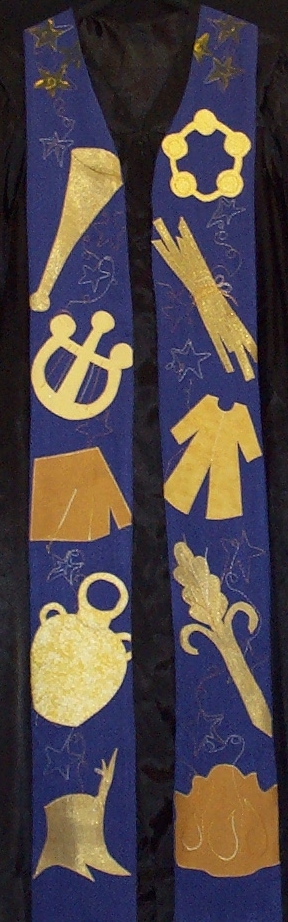
The story of Jesus brings hope, so do trees that absorb the old air and produce fresh air. So, the use of Jesse trees in our churches and homes tell not only stories of faith, but represent symbols of hope for the world. The tradition of the Jesse Tree dates back to medieval times. The name of the tree refers to the lineage of Jesse, mentioned in Isaiah 11:1: “A shoot shall come out from the stump of Jesse, and a branch shall grow out of his roots.” In creating a contemporary Jesse tree, one can use symbols from scriptural references and add others that have particular relevance for the local setting.

Learning is most significant if the message is delivered in several different means. If you have a Jesse tree you might also consider:


  • A prayer of dedication for the Jesse tree.

  • Incorporate hymns with the progressive decorating of the trees.

  • Wearing a teaching stole with Jesse tree symbols. Such as the one found at http://mysite.verizon.net/vzeoro2y/id36.html

  • Use the Jesse tree symbols on bulletin covers.

Jesse trees can bring new life to old, old stories in your congregation this Advent!

Wednesday, November 08, 2006

In the News

Vestments, in the past several weeks, have been making news headlines! The Red Mass, celebrated annually in the Catholic Church for judges, prosecutors, attorneys, law school professors and students, and government officials was celebrated at the beginning of the month. It takes its name from the red vestments worn by the celebrant and the people at the Mass to symbolize the Holy Spirit.

Secondly, it was a pleasure to read about the Rev. Gary Schulte as he was installed in New Hampshire to head the Congregational churches in that conference. Reportedly, hundreds celebrated by wearing white robes and colorful vestments.

Most recently, the news services have described the multicolored vestments that represent a new dawn, worn by Bishop Katherine Jefferts Schori as she formally took office Saturday as the first woman to lead the Episcopal Church.

Color has been used symbolically by all civilizations. I see it as a gift that unifies, focuses, and teaches. It also supports our emotions for celebrations and reflection. May we continue to embrace color through our faith and in our worship of the Almighty God!

Sunday, October 29, 2006

Bring on the Processional Banners!

Pamela Hardiman and Josephine Niemann who wrote Raise the Banners High! open their book with this statement: “It never fails. Every time processional banners are used in a liturgy, people seem a bit more alert, more attentive. …A good set of banners actually helps people celebrate liturgy in ways that other works of art do not. They help us participate with more of our senses.”

Have you thought about using banners in a processional instead of on a wall? I’ve had two occasions to help create such banners for worship. The first was for a Pentecost service. The banners were simple and bold strips of colored fabric suspended off a T-frame made from plastic tubing. These provided not only the colors of tongues of fire but a sense of the movement that must have been felt on that marvelous day the church first began. Secondly our worship leadership team wanted to try something different than the “typical” Nativity during the family Christmas Eve service. That year the children’s choir processed during the opening hymn with banners that had the figures for the Nativity graphically designed on them and placed them in the appropriate spots in the chancel as the story was told.

Recalling both of these first hand examples remind me of the energy that occurred during those worship services. I have to believe that the processional banners, unique to these services, were a worthy addition to helping us focus on praising God.

Tuesday, October 10, 2006

Inspired


Where do liturgical artists get their inspiration? Ultimately the inspiration comes from God but I find things like a walk through a museum, seeing a detail on a wonderful piece of architecture or the color of a wall in a coffee shop for example can spark that creative spirit. When I need to get out of the studio I often find my way to a bookstore which is yet another way to fuel my energy into a new project or revitalize one that has yet to jell. One of my recent finds in How to Read A Church, by Richard Taylor. If you aren’t familiar with this title you will enjoy the explanations of interpreting images in church art, understanding symbolism of individual animals, plants, colors, numbers, and letters, and considerations of how a church can reflect the Christian year. Happy reading!

Thursday, September 21, 2006

A Spider Made Me Think


A spider has decided to make my front storm door its home. While I was out of town it spun a beautiful web. At this point the children had watched the entire process and there was no way this spider was moving to a new location. Daily we see the web become more intricate or the spider catch food or the dew glisten on the strands, all while the spider gracefully moves about without disrupting a single strand.

Because we have so enjoyed this gift from the natural world it has made me wonder if we use the nature that God has given us to the best of our abilities in worship. I immediately think of cut flower arrangements which can be beautiful but sometimes they neglect to focus on or relate to the worship at hand. I heard of a congregation that used cut forsythia branches during Lent to represent the need to have simplicity during this season. As the days and weeks progressed the buds on the branches opened, timed so that at Easter this natural wonder matched the pageantry and glorious celebration of the Easter season. What a wonderful statement this must have made for this congregation!

We are approaching Advent and I wonder if my congregation will be using fresh greens instead of artificial. Their beauty and aroma will be reminders of the everlasting love God has for us. We’d love to hear the creative endeavors you have made to intertwine nature with our worship of the Almighty One.

Thursday, August 31, 2006

Multiple Intelligences in Worship

Are you a visual learner? Researchers estimate that 40-60% of people learn visually. You are correct if this sounds like something students and teachers are thinking about during back to school season. This is not, however, to be neglected by the faith community.

In 1983, Howard Gardner published his landmark book, Frames of Mind: The Theory of Multiple Intelligences, in which he detailed a different way of viewing intelligence that was quickly embraced by educators. Gardner, a Harvard researcher and professor, looked at intelligence as many-sided rather than as a general aptitude that could be measured by a paper and pencil test. He saw these intelligences as gifts within an individual that should be recognized and fostered.

How is your congregation addressing the needs of those that will be more attuned to worship through visual elements? Worship and Arts committees might brainstorm and find ideas beginning with banners fixed in one spot, power point staging, processional banners, flowers and other natural objects, clergy stoles and vestments, mobiles. This is not an exclusive list! We are encouraged and instructed again and again throughout the Bible to worship with all that we are…just don’t neglect the visual aspect.

If you have never taken a Multiple Intelligences quiz you might find
http://www2.bgfl.org/bgfl2/custom/resources_ftp/client_ftp/ks3/ict/multiple_int/index.htm interesting!

Monday, August 21, 2006

A Duct Tape Stole!?

I've just stumbled upon an old news story about a bride and groom that wore a wedding dress and tuxedo created out of duct tape. They were kind enough to complete the look by creating a stole out of the same supplies for the pastor. Reading this report has caused me to shake my head while at the same time chuckle out loud...what will someone think of next?

While maintaining reverence for worship, artists should think seriously about the materials that can be used for items such as stoles and worship banners. The days of felt glued upon felt are thankfully in the past! In my mind, any material that doesn't stretch is viable for these creations. When we think of worship banners the possibilities extend even further to include multitudes of types of papers. With both fabrics and papers, sheerness, transparency, texture, color, and pattern should be considered (and not forgotten) when seeking supplies for your next addition of something visual in worship. Happy creating!

Tuesday, August 15, 2006

Innovate, Educate

I worshiped, as a first time visitor, at a neighboring church this past Sunday. The worship space was large (probably seating 1000 people) with the focus being a stage that was central, wide, and very simply appointed. I suspect the simplicity was intentional by the architect because it allowed for this space to be multifunctional while at the same time it guided congregants focus. The drama of the visual immediately caught my attention as I prepared myself to worship. Upstage was a very well orchestrated visual that contained a ribbon floating and cascading through midair with three interwoven objects. I suspected that the objects were part of a sermon series or the "message of the summer" but I really couldn't conjur up what the message was. Thankfulfully I did not leave this service perplexed because the pastor was generous enough to eloquently explain the visual in his message.

Should I have had to sit through three quarters of a worship experience before getting the connection to the visual? Maybe this was good, because it got me thinking. And, thankfully I didn't leave the space still in a quandry. I ponder this today because I believe a large part of including the visual in worship is educating those that experience it. Including a description in the worship bulletin, make a verbal connection during the message, and reinforcing themes with the music chosen for the day are easy ways to educate about the visual images in worship. Adding or subtracting visual components to your worship space will keep the message fresh. Including scriptural references and thought provoking questions about what people are seeing will only enhance the church coming together as one body and strengthen our knowledge in what we believe.

Sunday, August 06, 2006

How to Celebrate Ordinary Time


As a Presbyterian, my church celebrates Ordinary Time, for us it is the longest portion of the church year. It is a time of spiritual growth and we celebrate with the color green. Ordinary in this situation does not mean regular or average but it comes from the word "ordinal" which simply means counted time. We our currently in the midst of counting our days until we begin Advent.

Professionally I am the designer of stoles and worship banners. I love using the many greens that nature gives us during the months of Ordinary Time. The fresh, lively spring greens to the rich and deep greens of summer and finally the soft and subdued tones of fall are all so visually satisfying. Personally, this time of year conjures up a few symbols such as: plant life to represent growth, creation (I love connecting to 2 Cor. 5:17-19), and the anchor cross and a heart to signify faith, hope and love.

There is much to embrace when we examine our Christian life, growth, and the mystery of God. So, how do you observe Ordinary Time devotedly and creatively for so many weeks?