Wednesday, May 09, 2012

Church Architecture: Our Heritage

Why is our church architecture configured the way it is? Did you ever stop to think about that? Occasionally I have had the privilege of leading an adult Sunday seminar class within my own home church community. It's always a pleasure partly because the attendees are often the older/wiser type and I adore their company. Secondly I am usually academically stretched when preparing these one hour talks. And this is a good thing. This past week I was really challenged with the subject matter of how the Reformation changed church architecture. I'm not an expert on this topic...I know the art component. But I do really enjoy research and am grateful to have opportunities to dust off my "teacher" hat. Here's a synopsis of the presentation that kicked off a four week series on sacred space....
A stone altar discovered south of Isreal. Might this be what Noah's looked like?
An early Old Testament example of worship was when" Noah built an altar to the Lord and, taking some of all the clean animals and clean birds, he sacrificed burnt offerings on it." Genesis 8:20 (God was pleased and Noah was blessed.)

      Another Old Testament worship setting is in Numbers 9:17, ‘Whenever the cloud lifted from above the Tent, the Israelites set out; wherever the cloud settled, the Israelites encamped’.…the tent was continually being re-pitched… and this was unique to other religions of the time that had to pilgrim to one set location to worship. Having worship today in the communities we live in is a blessing. The Old Testament way remains today. Thank you God. 

T   The New Testament tells of Jesus and then the early Christians worshiping in each other's houses.
This is what we think house worship might have been like.
It makes me think of what many of our worship spaces represent today also!
After the early Christians there was much growth and development including the reason why church architecture developed the way it did.

At one point it was believed that you needed to be a monk to get to heaven.
 It was difficult being a monk and it was difficult even getting to some of the monasteries as you can see in this image.
Gothic architecture was very vertical so that the building actually pointed toward heaven.
The beginning of the Protestant Reformation saw an outburst of iconoclasm....the removal of statues and images from churches. Because Reformists couldn't instantly build their own churches they made modifications in existing architecture.
This Roman Catholic cathedral in Grossmunster, Zurich is an example of a church who had their walls whitewashed of murals when the Protestants started to worship in the space.
The major message of the Reformists was people gathering in a spirit of intimacy for a shared ministry of word and sacrament. Therefore pulpits became large and often had a sounding board above them to give visual emphasis to the word and to help improve the acoustics.
This is the pulpit at Oude Kerk in Amsterdam. What a prominent figure it makes within the architecture!
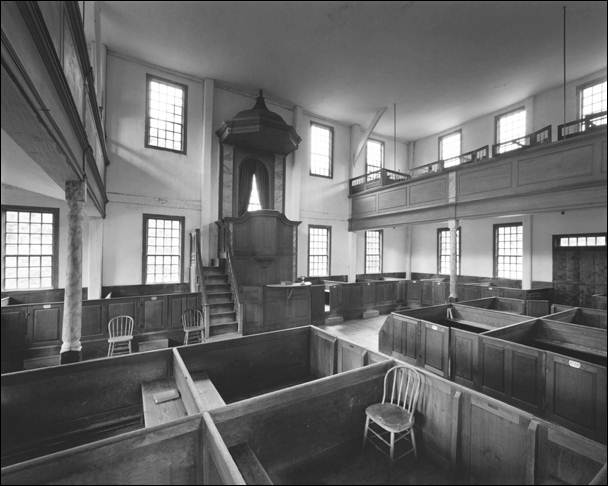
The Puritans were Reformers who in America built meetinghouses for their worship spaces.The image of the Sandown Meeting House in New Hampshire is another great example of how important preaching the Word was.

Reformed theology can even translate into the architecture of a mega-church. This is Coral Ridge Presbyterian in Florida. The pulpit with it's large sounding board is given major emphasis and the seats are arranged in a way for every participant can see and hear. The Reformers believed that Word of the Lord was for everyone and the architect of this large church kept that in mind

Sometimes great architecture has to be modified as time evolves. Miller Chapel at Princeton Theological Seminary as seen here in its current state has gone through three transformations and renovations since being built in 1834. The first converted the meeting house into a basilica. The second removed much Victorian era decorating and added a chancel. The last in 1999 allowed the Communion table to be placed forward in front of the pulpit.

Given that this post is from Carrot Top Studio, I suppose you're wondering what the Reformists would say about our worship banners and ministry stoles? We'd like to think that our works are not icons but merely pieces of fiber art that are used to enhance worship and help the people make a visual connection to the Word. Wouldn't be fun to have John Calvin or Martin Luther chime in on that subject? 

Wednesday, May 02, 2012

Preparing for Palm Sunday

Preparing for Palm Sunday? Now? Really? Of course, in theory, we should always be looking ahead to avoid doing things in haste. For example, the joyful celebration of Palm Sunday has not left my mind since hearing a friend describe her experience of Holy Week on a recent trip to Germany.  Throughout history many faith communities have reenacted the moment Jesus fulfilled prophecy and rode into Jerusalem on a donkey. Most use palm branches because that mimics what was done in Jerusalem. Have you ever paused to think about why Palm branches? Well of course...palm trees were part of the landscape so they were readily available. But my friend worshiping in Germany on Palm Sunday had the pleasant surprise of the congregation waving bits of boxwood cuttings to remember the joyful entry of Jesus. Why boxwood? Because the boxwood plants are part of the landscape in this part of Germany and were readily available. Carrot Top Studio is trying to be a better steward of our resources by using eco-friendly fabrics in our stoles as often as possible. This focus has heightened our awareness of other efforts made in this way. And therefore when I learned of the boxwood branches on Palm Sunday I had an ah-ha moment. This sounds like a very sustainable demonstration of using what is local.  I know some congregations use the palms at the end of worship to turn them into ashes for Ash Wednesday, and some people fold their palm branches into crosses as a devotional image to focus upon, but what about all of those palm branches that just get thrown away at the end of worship.....after the expense of shipping them a great distance in the first place? Are there better ways to celebrate? There are eco-friendly efforts among some growers so at least the palms are being provided in a way not to destroy plants. If you are interested in these eco-palms you might appreciate this article. But, maybe we can go a step further in our efforts as we plan for what will visually enhance our worship services to accent the Word and draw us deeper into our faith. Maybe you have ideas you can share? Regardless thanks for listening! Putting my soap box away....now...


Friday, April 27, 2012

Journeys

Martin Sheen journey's in The Way
Sometimes when I have to do routine, no thought required tasks in the studio, I pop a movie in to keep me motivated. Yesterday I watched, The Way starring Martin Sheen. It focuses on his character's journey on the El Camino de Santiago. Have you seen it? I've always enjoyed Martin Sheen's acting and he did not disappoint here as emotions ran the gamut while I laughed, cried and was awestruck by the scenery while cutting fabric for your new stoles.This movie is not necessarily a theological piece but one reviewer says he left the theater wanting to go on "a walk to find what Celtic Christians called the thin places … places in which God's presence is more deeply felt. A pilgrimage to … it didn't much matter where, as long as it brought me closer to God."

DuBose Conference Center, TN
While I'm dreaming of where my pilgrimage might be (I've always wanted to hike the Appalachian Trail) I've been working on a talk I'll give for an adult Sunday School seminar in my home church. The series is entitled "Sacred Space" and I will present the opening session which will focus on "Church Architecture: Our Heritage." We're looking at sacred spaces basically since the Reformation. It's made me think once again about what our worship spaces say regarding our liturgical practices. Does the journey into worship allow for a gathering of community? Does the worship space allow for movement...processionals, coming forward to the Lord's table and liturgical dance for example. Does the space allow everyone to be active participants in worship? Does the placement of the font indicate that Baptism is a communal act? 

Whether your worship space is as simple as this outdoor space shown at left or something much more complex, try to see it with fresh eyes. Sometimes little things can make a difference. The movement of a piece of furniture (maybe the font), the removal of a too long used worship banner or where the reader of the scripture stands can draw attention to what the worship space is declaring about our faith and help draw us closer to God as we journey with Him.


Interestingly Image (a journal of literature and the arts) releases a movie list each year. This year they focused on the "Top 25 Road Films" --they're stories about journeys! Quite a few on this list I haven't seen and now I think I need an arts and faith discussion group to coincide with my viewing -- and maybe a few more mundane tasks so I can work my way through the list!

Wednesday, March 28, 2012

Multi-Sensory Worship

I had the opportunity this week to spend any evening with friends as we shared a Seder dinner. It was meaningful because we rejoiced with the story of the exodus through the spirit of the Jewish tradition by giving thanks for deliverance and redemption. We also recalled  that Jesus asked all of us to do this in remembrance of Him. Many of us reenact part of the Seder dinner at our various Communion Services, but the entire Passover ceremony brings a profound sense of meaning. I was touched by this ancient  teaching tool because it applied to all of my senses.


See this "Joyful Feast" stole & other Communion stoles here.
I actually recall a Seder dinner the family life committee sponsored in the church community that I grew up in. Despite the fact that many years have gone by since this 'event' occurred the memory is vivid probably because the meal was multi-sensory. 


Why dwell on this? First it's appropriate as we prepare for Holy week! Secondly it is a great example of how including multi-sensory experiences help us be engaged and place the main idea into significant context. Classroom teachers know that if you can incorporate the visual, the auditory and the tactile you can imprint a memory. Isn't that what a Seder dinner does? How else can we learn from this teaching model as we plan our worship services?

Tuesday, March 13, 2012

Stoles Created from Congo Cloth

Trying to be a better steward of this good earth a call was put out to clients and friends to find sources for fabrics that were organic or sustainable that we might start incorporating into our ministry stoles.

One connection led to another which led us to a group within the Mennonite church that hosts a project that connects church women and men in North America and the Democratic Republic of Congo through the beauty of cloth, prayer and personal relationships.


Cloth is a hallmark of Congolese culture and creativity. We, like many others, were quickly drawn to its bold beauty. We therefore anxiously anticipated the appearance of the first fabrics we purchased!


The day arrived and tears ran down our face when the package was opened and the story of the fabric was read. The motto of this ministry is "every stitch a prayer." Ahhhhh. Sigh. How lovely!


This stole can be seen in full here.

And now we've had time to sew with just a bit of this sumptuous fabric to create a design for Carrot Top Studio's Easter collection. This stole (detail at right) uses the Congo fabric just in the border but we look forward to using the other Congo fabrics we have added to our fabric stash in even bolder ways. Two projects in the Congo will receive monetary benefits from the sale of these fabrics. One is a sewing training center and workshop to help start young women on their careers. The other is a sewing group that helps women who have been victims of sexual violence by teaching them fiber arts skills.


You may read more about the Congo Cloth Connection here.


Wednesday, March 07, 2012

Celebrating the Christian Year with Food

I was thrilled to discover  the book A Continual Feast by Evelyn Birge Vitz. It's a great match for my passion for honoring the rhythm of the church year and for creating in the kitchen and trying new foods. Maybe this suits you also? The author speaks of fasting and the giving up of particular foods during the season of Lent. The giving up of certain foods and culinary pleasures can enhance this period of prayer and turning to God. If you are keeping everything simple during this season--including your meals--you might appreciate this recipe included in the cookbook.


Lentils with Cumin and Coriander


1 cup dried lentils
5 cups water
2 medium onions, chopped
2 cloves garlic, shopped
1/4 cup olive oil
1 teaspoon ground cumin
1 teaspoon ground coriander
1/2 teaspoon salt
freshly ground pepper


It was for a dish probably quite like this one that Esau sold his birthright (Genesis 25). Lentils especially strongly spiced, were a popular dish at the time of Christ.


Rinse the lentils and carefully pick over to remove any pebbles.


Bring 5 cups of water to a boil in a large saucepan. Add lentils and boil for 2 minutes, then remove them from the heat and set aside for 1 hour.


In the meantime, saute onions and garlic in olive oil. When the lentils have soaked for 1 hour, add the onions, garlic, cumin, and coriander to the pan with the lentils.


Cook, partly covered, for 1 hour more, stirring occasionally, until the lentils are quite soft and the water is mostly absorbed. Add more water if necessary to keep the dish from drying out too much, but the mixture should be thick.


Add salt and freshly ground pepper; taste for seasoning.


Yield: 4-6 servings.


What is served at the table when we break bread together can be a visual reminder of the season of the church year at your church dinners and in our homes. Cooking, serving and sharing food enriches our lives in many ways...even during Lent.

Friday, February 24, 2012

Lent has begun and we shall try to embrace simplicity in our daily lives. Likewise we clinch minimalism in our worship spaces as we strip them to the humblest of symbols such as this hand-woven purple cloth. The unassuming cloths and symbols in our worship spaces are a visual way of fasting before the joyous feasting of the Easter celebration.  Traditionally the church uses the color purple during this season to represent penitence, and solemnity. Yet the color purple also associates with the dignity of royalty and reminds us of the hope of Christ the King who we will honor and celebrate in the Resurrection on Easter Sunday.

The following is an interesting bit of information regarding purple.  It is from “A Noble Color” by Christina Garton (Weaving Today, 9.28.11.) The author shares: Many of us have heard the term “royal purple” but do you know the lineage of this noble dye? True royal purple, also known as Tyrian purple, was first discovered by the Minoans of Ancient Crete. However, it was in Phoenicia—whose name translates as purple—that the dye became famous.

In much of ancient Europe, purple dyes were rare, hard to make, and expensive, so only the rich and powerful could afford them. Wearing the color purple was an advertisement of social status and Roman laws restricted its use. Only the emperor and statues of the gods could wear trabea, togas dyed entirely in purple. In Byzantium, the color was similarly limited to the imperial family.

This highly coveted dye comes from a not-so-lofty source: the mucus secretions of predatory sea snails. It takes thousands of snails to dye even a small piece of cloth. Fortunately for us, there are cheaper—and easier to collect—natural and synthetic purple dyes, making the color of kings available to everyone. 

By using color and simple symbols in worship may we journey through Lent in a way that we can be prepared to celebrate joyfully the mysteries of our salvation.

A special note: Thanks to Rev. Dawn Carlson for sharing her weaving and the Noble Color article! We appreciate clients like Rev. Dawn who enthusiastically embrace including the visual in worship and are so eager to share what they do with us. This helps our little, quiet studio feel warm and unclouded all throughout the year. 


Thursday, February 16, 2012

Upon a Mountain

It was upon the mountain where they had gone to pray. He was changed completely .Shining! Glory! We celebrate the transfiguration this Sunday.


Today we share a visual to meditate upon:
Livan Kudriashev, Luminescence, 1926

...and some words to enhance our understanding:

Suddenly they saw him
    the way he was,
the way he really was
    all the time,
although they had never 
    seen it before,
the glory which blinds
    the everyday eye
and so becomes invisible.
    This is how
he was, radiant, brilliant,
    carrying joy
like a flaming sun
    in his hands.
This is the way he was--is--
    from the beginning,
and we cannot bear it.
    So he manned himself,
came manifest to us;
    and there on the mountain
they saw him, really saw him,
    saw his light.
We all know that if we really see him we die.
    But isn't that what is required of us?
Then, perhaps, we will see each other, too.
Madeleine L'Engle

Together we celebrate the promise of the living Christ!

Friday, February 10, 2012

St. Valentine

In mind Valentine's Day is a holiday trumped up by the greeting card companies to get us to buy their products. I don't buy (ha, ha!) into it. In my mind love is better expressed in more surprising and subtle ways than a marketing department of a major corporation trying to convince me to say what I feel. How did it come to this? 

It seems as if not a lot is known about Saint Valentine other than he was martyred for not being willing to give up his Christian faith. Now that's not trivial and should be celebrated and learned from!


I do not know the origins or artist of this lovely image of St. Valentine. I am drawn to the art because of the magnificent vestments. These aren't the style of what we create at Carrot Top Studio but we certainly admire this type of intricate design and fine craftsmanship. Additionally, red seems to be an appropriate primary color on the chasuble to represent the passion this man must have had as he reportedly  married Christian couples, was imprisoned and then spent his time converting the prison guards! 

May we all find unique ways to celebrate,  learn from and remember St. Valentine!

Wednesday, February 01, 2012

Experiencing Unity

Where have you experienced moments of unity with your brothers and sisters in Christ? Last week while in Haiti I had this experience in worship as confession was professed aloud, while together singing one song at youth group but in different languages, and while working side by side with our new Haitian friends to brighten the interior of the cinder block school building with bubble gum colored paint. But one of the highlights of this experience for me was painting silk with the La Femme de la Croix (Women of the Cross). Monday afternoon found me under this tree in a patch of dirt and dust anxious to see how this project would be accomplished.

In no time at all the supplies had been assembled. A small table was found and covered with a large sheet of plywood and we were ready to create.

The group this time consists of young women ranging from preteen to young adult. They first wet the silk.

Then trays are set up with Dixie cups and recycled Communion cups (it's a sustainable project!) These circular receptacles will help establish the ringed designs in the silk.

Carefully the silk is placed on top of the tray and poked into the cylinders. Many hands make light work in this step!


And then the fun can commence! Paintbrushes apply the dye to the silk. The artists have a wonderful sense of color theory and there rarely is an end product that isn't stunning and bright. If I close my eyes I can still hear the chatter and giggling as the group worked together....and really, these joyful sounds could have been any women in community in any part of the world. Unity.

Get a group of charming young ladies together and what happens next? The boys show up! Trust me, they were quickly shooed away!

After several hours, the work was seen to completion and the silk was set on the rooftop to dry.

The next day the silk was ironed by Marietta, the lead of this project and her friend Jenny. 

All the artists get to keep one scarf for themselves and the remainder are brought back to the United States and sold through my home congregation. The monies are sent back to Haiti to support the education of these artists. Carrot Top Studio buys the silk and cuts it into symbols and images to applique onto ministry stoles. Our current collection is available here. We donate the profits back to La Femme de la Croix. 
Haiti silk is transformed into palm leaves on this Lent stole.
If you'd like to know more about the work that's being done through the ministry of Pastor Pierre you may read my daughters' blog from our trip last week, here. As for Haiti as a whole we were greatly encouraged to see fewer tent cities than we did on our trip in June and to hear Pastor Pierre speak highly of the work that the Haitian president is trying to do.


Thursday, January 19, 2012

Word as a Work of Art

When we think of art in worship we often think stained glass windows, carvings on the Communion Table, or liturgical vestments. But can a Bible be a work of art? Can it make a visual connection with the reader? Of course we have seen this throughout history especially during the Medieval times. Have we lost this tradition in our contemporary society? We certainly have many--maybe too many--options for Bibles today but here are a few that include amazing art intermingled with and supporting of the Word.
The St. John's Bible
For several years I have follow the work (online) of the Benedictine monks of St. John's Abbey in Minnesota who have worked with a team of calligraphers and artists to create the St. John's Bible. This morning I have discovered that La Roche college, in  my home town, has acquired one of these hand-illuminated Bibles. I am bubbling over with anticipation of being able to see it. One can also visit the Abbey or view the Bible while it tours to a variety of museums.


The Four Holy Gospels
Secondly, The Four Holy Gospels is an exquisitely designed and produced edition of the four canonical Gospels in the English Standard Version, published in commemoration of the 400th anniversary of the King James Version Bible in 1611. Makoto Fujimura is the artist behind this work. He works tirelessly on behalf of quality, faith based media. His art skillfully combines ancient art techniques with contemporary interpretation.


And lastly I have long been enamored by the work of expressive calligrapher Timothy Botts. Many years ago I was able to attend an artist talk of Mr. Botts. I think it was long enough ago that the presentation was done with a slide projector! I believe he was the first artist that I ever heard speak openly and passionately about how his faith was intertwined with his work. There need to be more artists like him today! Including an illustrated Bible he has a published a variety of Christian books. A Carrot Top Studio favorite is his visual interpretation of the Psalms.


In ministry and worship we should not neglect that fact that Word can be a work of art and can draw us closer to God so we may learn better how to worship and serve Him.

Tuesday, January 10, 2012

Hands: Symbols of God's Love

This is a photo of my grandfather at his church many years ago. His hands are one of the memories I have of him. They seemed very large to me. My grandfather was a hard worker. An ethic that has now passed through several generations beyond him. His hands allowed him to have many jobs over the years to financially provide for his family, they allowed him skill and pleasure in the wood working shop, but even better yet they allowed him to serve the Lord in and out of his church. When I came across this old photo I was struck by the hands at rest yet seemingly ready for the next task with the background sign of "God is Love". A sign and a symbol of what I believe people were able to see through my grandfather's work.


This weekend I traveled across the country to celebrate the end of my grandfather's earthly life. He passed on before Christmas at the age of 96. As I left the studio on Friday I pondered about what colors and symbols I might encounter at the memorial service. End of life rituals and celebrations intrigue me because there seems to be great variety in what is comforting and what connects those to their faith at this time. I see the variety as a gift. I am visual (no surprise) so of course I found the symbols in and out of worship comforting.

The family was nourished by conversation and food at a meal prior to worship. It was prepared by the hands of a group at my grandfather's church. These were hands that worked in the kitchen with happy hearts out of respect for the work that my grandfather had felt was so important for so many years.

I saw hands providing comfort. My cousins hand patted his mother's shoulder as his arm wrapped around her while we waited to go into worship. My mother's hand gave a loving pat to my father as they walked together into the sanctuary. 

The hands of the pastor were expressive and emotional as she shared comforting scripture and personal stories of how my grandfather had ministered to her while she was with his congregation. 

And I appreciated the hands that had used fiber arts to enhance the worship space. The still present Christmas tree was embellished with Jesse symbols; symbolic of the revelation of grace and the faithfulness of God. A banner of simple blocks of white and gold even though meant for Christmas was also a reminder of God's brilliance and the purity of Christ's life and resurrection. And the icing on the cake was the pastor's stole that proclaimed "JOY" in a way that nobody could have missed the message. 

As we left the church to travel to where we were to rest for the night, God's hand created one more gift for the day...


...one of the most incredible sunsets I have ever seen. The magnificent and powerful colors enrobed us, as a symbol of God's love.


Monday, December 19, 2011

Advent: Blessing the Christmas tree

Advent traditions vary but the reasons remain the same: to prepare our hearts for welcoming God's gift of light and love, his son Jesus. Here is one idea to help connect a visual symbol to the message of the season....


The use of the Christmas tree is relatively modern. Its origins are found in the medieval mystery plays which depicted the tree of paradise and the Christmas light or candle which symbolized Christ, the Light of the world. We see the evergreen tree as a reminder also of God's everlasting love for us.


According to custom, the Christmas tree is set up just before Christmas and remains in place until the solemnity of Epiphany. Whether the tree is in a home or in the church we like the tradition of a tree blessing after the tree is decorated and before the tree is illuminated. Here are two suggestions:


Lord God,
let your blessing come upon us
as we illumine this tree.
May the light and cheer it gives
be a sign of the joy that fills our hearts.
May all who delight in this tree
come to the knowledge and joy of salvation.
We ask this through Christ our Lord.
Amen

God of all creation,
we thank you for this tree,
which brings beauty
and memories
and the promise of life to our home.

May Your blessings be upon all that gather
Around this tree,
And who keep the Christmas festival by its lights.

We wait for the coming of Christ,
the days of everlasting justice and peace.

You are our God, living and loving,
forever and ever.

Amen
About the pictured stole. This limited edition is a reminder of the folktale story of The Three Trees. At Carrot Top Studio we enjoy creating uniquely themed stoles that help celebrate the church year calendar and draw us closer to God in worship through visual images. 'The Three Trees' stole has sold out but you may go here to see our current collection of ministry overlay stoles and deacon stoles.

Tuesday, December 13, 2011

Advent: The Light


This Advent stole is seen in full here.

Advent traditions vary but the reasons remain the same: to prepare our hearts for welcoming God's gift of light and love, his son Jesus. Here is one idea to help connect a visual symbol to the message of the season....

This year I seem to be very drawn to scriptural images of light and therefore candles. We use candles in community worship but why not in private worship also? Be still and combine the visual image of the candlelight with a breath prayer for a time of meditatio . Breathing slow and deep as you meditate on a verse of Scripture can be a special way of being restored in his peace.  Breathe in slow and deep as you whisper or think on a Bible phrase and hold your breath…then exhale. Here are some Advent suggestions:

  • To model Mary's prayer- “Let it be to me… according to your word” (Luke 1:38)
  • Remember the reason for the season“Jesus, my One Thing… nothing else” (based on Psalm 27:4)
  • For when you get caught up in the frenzy of the season- “Peace… Be still”  (Mark 4:39)
On the subject matter of light and candles I'd love to also share this title with you written by a dear friend. Dave pastors in an urban Pittsburgh neighborhood. I Will Hold My Candle is a wonderful book that is a culmination of Christmas Eve stories Pastor Dave has shared in worship over the years. I am finding the stories enjoyable for all ages and each contains a lesson or message that can be applied to your own life no matter what your life circumstances are. Shhhhh......it's my gift of the season for everyone from the letter carrier to my mother in law's caregiver to my mom. It can be purchased on Amazon here and Lulu here.

What is your book recommendation for the season? Have you published your writings? Tell us about your recommendations and work because we'd love to read what you've written! 

Monday, December 05, 2011

Advent: The Crib


Advent traditions vary but the reasons remain the same: to prepare our hearts for welcoming God's gift of light and love, his son Jesus. Looking beyond Carrot Top Studio'spastor and deacon stoles here is one idea to help connect a visual symbol to the message of the season....


At one time the making of the Christmas crib was as important a part of every household activity as that of the church where we still see the annual preparations.Tradition tells us that it was St. Francis of Assisi who created the first crib, in honor not only of the infant savior but also of the animals who had come to worship in the stable. This crib was reportedly made with the wooden materials St. Francis had on hand...reminding us that Christ was born in a place that was "on hand"....he didn't come to the palatial palace that this king was anticipated arriving in. Why not create your own nativity scene without store bought, mass produced elements, using just whatever you have on hand? And think about giving special place to the animals, perhaps including more than the traditional ox and ass. 


Seeing this photo by one of our favorite college chemistry students reminded us that using what you have on hand can work!


Tuesday, November 22, 2011

Sustainability


I am being more and more awakened to how much better we can do at taking care of God's creation. At home, at work, and in our faith communities. Whenever possible at Carrot Top Studio we try to use eco-friendly fabrics or re-purposed fabrics. We label the stoles as such on the website so you are aware that you can make purchases that support these endeavors. For example, this white labyrinth stole was crafted from bamboo fabric. We love this fabric because it has luxurious softness. The growing process of bamboo is very environmentally friendly. The manufacturing processing of bamboo has room for growth to become more chemical free but we like to offer this fabric to say to the fiber industry that we support the direction you are going (or growing-ha, ha!)


In the studio we also are mindful of using our materials in ways that don't create excess waste. Thinking about this in combination with the upcoming Thanksgiving celebrations in the United States makes me wonder how we do in not creating things that just get thrown away after use in our worship spaces. My home church will host a meaningful Thanksgiving Eve community worship service tomorrow night. The sanctuary will be embellished with plants and vegetables that are reflective of the harvest in our local area. For example, the wonderful color and shapes of many pumpkins will be in abundance. I suspect many of our clients do something similar. What do you do with the pumpkins afterward? Of course you can bake them down for pies (even if they aren't what the grocery store labels as "pie pumpkins".) Here's another suggestion that is a favorite in my household:


Pumpkin-Apple Bake

1 small pumpkin (so it will fit in your oven)
raisins
sugar
butter
chopped apples
nuts
cinnamon


Preheat the oven to 350 degrees. Cut off the top of the pumpkin and scoop out the seeds. Mix chopped apples, raisins, nuts, sugar, and cinnamon. (Filling may be varied to include walnuts, pecans, apricots, dates or cranberries.) Pour mixture into the pumpkin, and dot with butter. Replace the top of the pumpkin. Bake it on a cookie sheet for one hour and 15 minutes to on hour and 30 minutes.


Scoop out some pumpkin with each spoonful of the apple mixture. The bonus gift is that the pumpkin, which will darken slightly while baking, will look beautiful on your Thanksgiving table!


Blessings for your Thanksgiving....Thursday if you are in the USA and in every situation, everyday!

Wednesday, November 16, 2011

A Pause for Thanksgiving

A week from today, the United States of America will pause for a time of Thanksgiving. I am thankful for this day with family and friends that allows us a breath and a pause as we break from our normal routines to just simply enjoy each other's company breaking bread together.   

At Carrot Top Studio we are thankful for all the believers that we get to interface with. You and your ministries never cease to inspire and encourage us! 

In the spirit of thanksgiving I thought I'd share a favorite hymn  to our God and creator. The text is from the 1920's written by Katherine Davis. The tune is a charming Welsh folk melody.
Let All Things Now Living

May we carry on, giving thanks always (Eph. 5:20)

Advent Wondering

Advent traditions vary but the reasons remain the same: to prepare our hearts for welcoming God's gift of light and love, his son Jesus. Looking beyond Carrot Top Studio'spastor and deacon stoles here is one idea to help connect a visual symbol to the message of the season....


An "I Wonder" board is a wonderful visual tool in a church hallway, a Sunday School classroom or the home. It could be as fancy as a cork bulletin board gussied up with Advent symbols or as simple as a white board or a large piece of paper taped to the front of a refrigerator. Designate the space, provide a writing tool and invite the wondering to cascade as we move through the season and work our way through the story that led up to Jesus' birth. The 'wondering' thoughts will help some people to pause in the midst of the rush and others to think deeper as they read what others have written. Seeing the 'wonderings' all grouped together will create a visual testimony to the mystery of the birth.


Of course we love stoles, paraments and worship banners but we also believe in using unique visuals such as the "I Wonder" board to draw us deeper into our spiritual formation. Try a new visual idea during this Advent season!